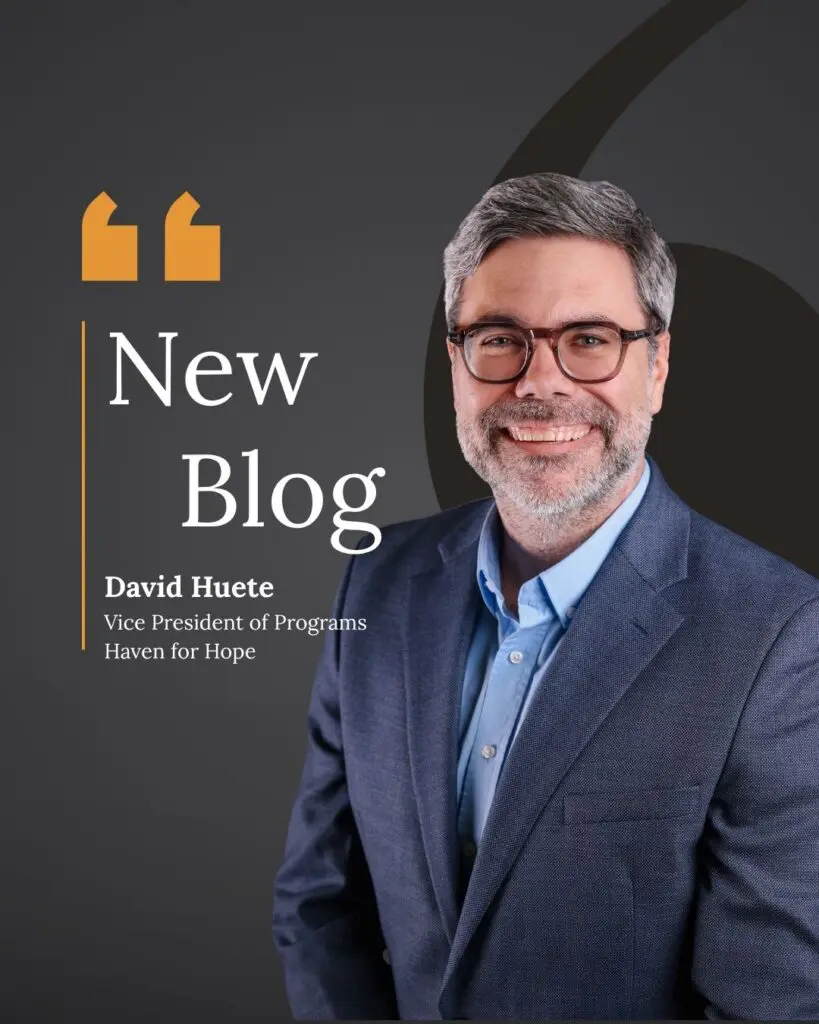

By David Huete, Vice President of Programs
Engagement isn’t something you demand. It’s something you design for.
That’s not just a philosophy. At Haven for Hope, it’s something we had to learn, and then act on.
In 2023, the Haven team started noticing something on our campus that we couldn’t ignore; young adults just weren’t engaging in our system the same way older adults were. They weren’t coming in for shelter. When they were, they weren’t staying. And when they stayed, they weren’t engaging or completing programming. Ultimately, they weren’t achieving the same stability and housing outcomes as our other unhoused demographics.
It would have been easy to frame that as a motivation issue. It wasn’t; it was 100% a design issue on our part.
Young adults (ages 18–24) are in a completely different place developmentally, socially, and psychologically. Many are navigating independence for the first time without stable support systems. Many have histories of complex trauma. Our data reports that 27% of our young adults report being involved with the foster care system. But almost all are still figuring out identity, relationships, and what stability may even look like for them. Dropping them into a system built for older adults and expecting the same results just didn’t make sense.
Knowing that we had to do something better, we built something different.
The Young Adult Program at Haven for Hope is our attempt to better align programs, services, and physical space with that reality. The biggest shift has been around how we think about engagement itself. Traditional models tend to be compliance-driven: show up to this appointment, complete this task, follow this structure, repeat. That works for some populations, but for young adults, it’s the fastest way to lose them. If there isn’t trust and connection, the rest doesn’t matter.
So, we’ve focused heavily on relationship-building as a key piece of our intervention. Having dedicated case management and spaces for young adults to build community. Options for them to meet both individually and as groups. Slowing things down, focusing on the best long-term outcome, not the quick win. While it may sound simple, in a large, complex system like Haven for Hope, it requires intentionality.
We’ve worked to create an environment that feels different. Less institutional and more connected. Young adults are highly influenced by peer dynamics and sense of belonging, whether we design for that or not, so we decided to design for it.
Another key difference is the focus on what comes next. This is a stage of life where trajectories get set. We can’t miss that window. Stabilization alone isn’t enough. We’re helping them build toward something bigger: education, employment, independent living skills, and housing.
What’s important is that this program isn’t operating in a vacuum. It’s layered into a broader model that values and navigates towards services and programs provided by our community partners. Young adults require more flexible pathways. We value a no wrong-door approach into services, with support that prioritizes engagement.
Three years later, we know it’s working.
In these past three years, we’ve provided safe shelter to 505 unhoused young adults. Out of that, we’ve helped 143 unhoused young adults move from the Haven campus directly into permanent housing, a rate almost three times as high as program inception. But numbers only tell part of the story. The bigger shift is that we’re seeing young people actively choose to engage in our system and seek safety. They’re staying, participating in programming and services, and starting to build something bigger for themselves in ways we weren’t seeing before.
There’s a broader lesson for all of us in homeless services.
Systems for the unhoused are often designed as if one model should work for everyone. In reality, different populations need different approaches. Young adults are a clear example of that, but they’re not the only ones.
If we want better outcomes, we must be willing to look at where our systems aren’t aligned with the people we’re serving, and then actually change them.
That means asking a different question. Not “Why aren’t young adults succeeding here?” but “Why would we expect them to, given how this is designed?” That shift in thinking has made all the difference in both our programming and our outcomes.
The work hasn’t stopped. We’re still learning, and there’s a lot we don’t have figured out yet. But this program has reinforced something that applies well beyond young adults.
Engagement isn’t something you demand. It’s something you design for.
Please consider supporting our mission by volunteering, donating essential items, or giving today.