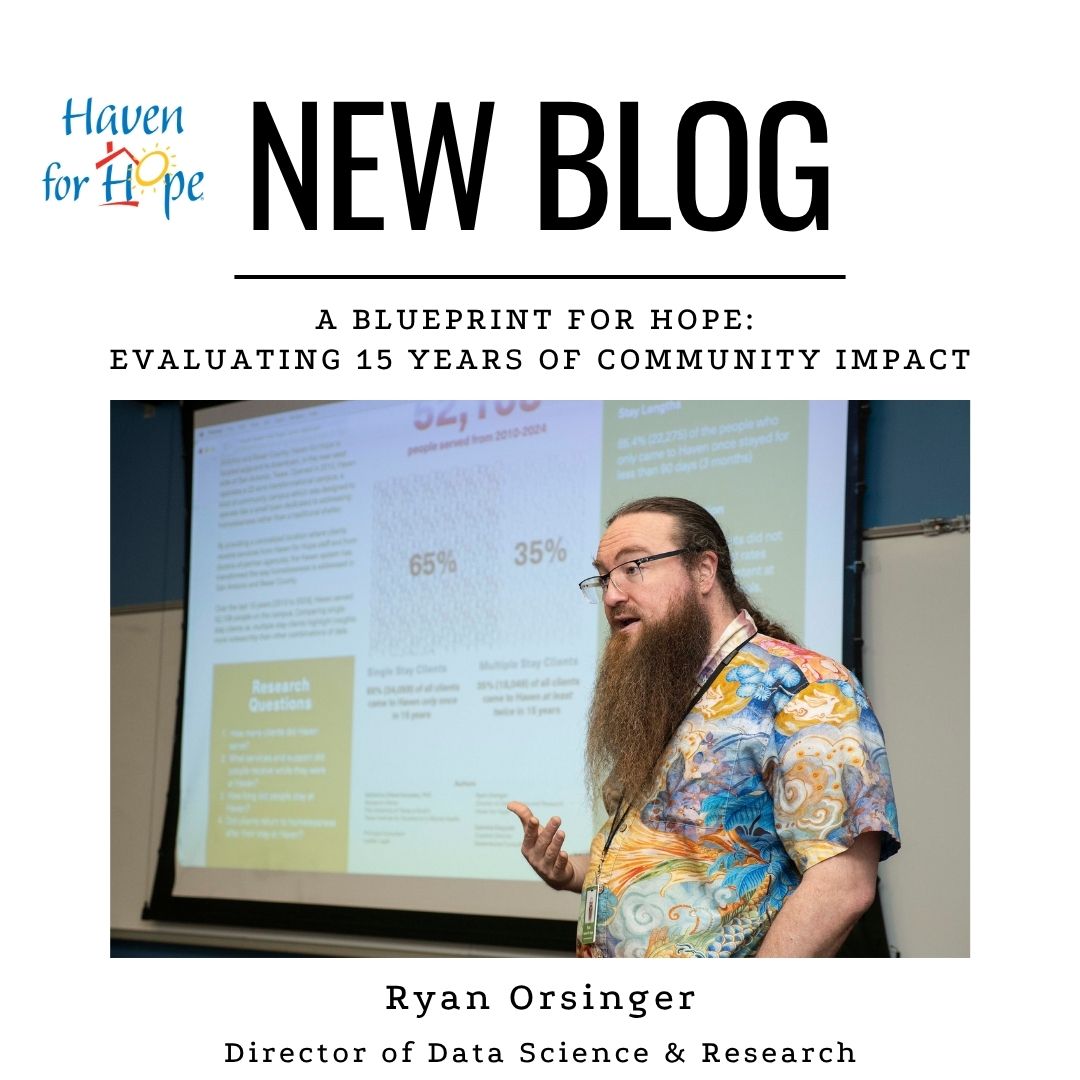
By Ryan Orsinger, Director of Data Science and Research
An inside look at the data behind Haven for Hope’s first 15 years and why those numbers shaped the conversation Haven’s leadership brought to San Antonio’s community leaders this June.
On June 2nd, community leaders from across San Antonio gathered at the San Antonio Botanical Garden for the public unveiling of A Blueprint for Hope — 15 Years of Community Impact & Outcomes at Haven for Hope. President and CEO Rhonda Mundhenk presented the findings to an audience of policymakers, nonprofit partners, and civic leaders, framing the findings not only as a retrospective but as a planning tool for what comes next in San Antonio’s response to homelessness.
Since its opening in 2010, Haven for Hope (a 22-acre community campus next to downtown San Antonio) has operated as much more than a traditional shelter, and A Blueprint for Hopetells that story through longitudinal data analysis measuring long-term outcomes. Traditional shelters, where available, provide sleeping and basic services, while Haven for Hope operates more like a small town dedicated to helping people end their experience of homelessness. Services include not only temporary housing and emergency shelter but wrap-around services, including but not limited to case management, housing assistance, workforce development, and medical services such as health care, dental, and behavioral services provided by on-site partners.
This is precisely why the findings of this research needed to be shared directly with community leaders, and why the Blueprint release Botanical Garden event matters. Homelessness is not a problem any single organization can solve in isolation. The decisions made by city council, county commissioners, healthcare systems, and philanthropic partners all shape the conditions that intersect with homelessness – where Haven for Hope operates. Presenting this analysis to that audience was an invitation to make those decisions with a shared, evidence-based understanding of what is happening on the ground and what interventions are most effective.
A Blueprint for Hopeexplains the long-term impact of Haven for Hope by answering not only how many people were served or how many services were delivered, but also longer-term questions such as:
How did the Haven for Hope campus become the catalyst that redesigned San Antonio and Bexar County’s response to homelessness?
How has the Haven for Hope system of care and service delivery model changed over time to meet people’s needs?
Did people return to homelessness after their stay at Haven?
Haven for Hope has served 52,108 people (both individuals and families) throughout its first 15 years. Here are some of the key data takeaways from this analysis:
Across Haven’s first 15 years, 34,059 people (65% of 52,108 people) only came to Haven one single time.
Of these 34,059 people (65%) who came to Haven only one time:
- They are twice as likely to be in a family unit and report lower rates of behavioral health challenges, substance use disorder, and disability.
- After leaving Haven, single-stay clients did not return to homelessness at rates over 90% across the 1-, 5-, and 10-year intervals.
- 65% of these single-stay clients stayed at Haven for less than 90 days.
The remaining 35% (18,049) of Haven for Hope clients have had at least two stays at Haven across 15 years.
This group trends 5 years older, on average, and reports significantly higher rates of disabling conditions.
67% of the people who came to Haven multiple times stayed at Haven less than 90 days.
Of these 18,049 people, 48% stayed at Haven exactly two times in 15 years, while 52% had 3 or more visits. This shows that even among people who needed Haven multiple times, there are varying levels of need and different barriers.
What the data demonstrates is that there is not a single “type” of homelessness. While each individual and household story is unique, the data shows us that most of the people who stayed at Haven for Hope were able to resolve their homelessness through a single visit. This indicates a high level of situational homelessness in the community, while the people who came multiple times may face higher barriers or lack of social support — a more episodic or chronic experience of homelessness. Altogether, homelessness is a trauma, and it is important to realize that resolving homelessness is not always linear. What matters most is that the Haven system has been able to provide people with the support and differentiation of care to meet people where they are at.
This was the core message Rhonda delivered to the room on June 2nd: the goal is not a single intervention that works for everyone, but a system flexible enough to meet people with differentiated care for their needs – to meet them where they are.
Creating an Integrated Community System
How Haven for Hope has been able to accomplish these long-term outcomes is due to San Antonio’s Integrated Community System, where Haven for Hope is the keystone, providing a physical address not only for thousands of people experiencing homelessness but a physical address for the policy issue of homelessness.
San Antonio created alternatives to the traditional interventions across the crisis response systems that provide additional options beyond emergency rooms, county jail, and/or psychiatric units. While the traditional options are still available, these programs expand the system’s capacity to support people in alternative settings more suitable for recovery and integration into the community. Many of these options intersect on the Haven for Hope campus, not only because of the number of people served but because Haven provides a single address for the system response to coordinate alternative interventions at scale.
There are five layers that sustain the complex services and relationships across San Antonio’s Community System model and provide the framework for other communities to develop their own version of a community campus. Each layer is a critical component that is needed to shift the response from individual interventions to community-wide interventions to better serve people and improve the system response.
Haven serves the following roles in the community:
Operational Role (provides operational support for the day-to-day management of a 22-acre campus serving a design capacity of 1,450 people)
Service Provision Role (delivers client services on the campus directly through organizational staff and on-campus partners)
System Synchronization Role (engages in system-level coordination of entities across the community to serve people experiencing homelessness)
Haven System Fiscal Impact
The fiscal and economic impacts of homelessness cut across nearly every sector and aspect of modern society. As a result, no single entity owns the entire issue of homelessness on their own. As explained by Tsai et al. (2024), “One of the reasons why homelessness remains policy resistant is because communities are already spending their budgets on various initiatives that end up siloed or conflicting,” and siloed approaches face system friction when attempting to produce durable, transformative results. Solutions that produce results that are more than the sum of the parts involve systems thinking.
The data below provides the 15-year cost-per-stay figure on San Antonio’s community campus. This paints a more accurate picture than per-year costs, since average lengths of stay are less than a year, and a single bed will turn over throughout the year, serving multiple clients:
Average cost per diem (not adjusted for inflation): $37.70 per bed night.
Average stay length: 108 days.
Average cost per stay: $4,072.
In the Cost-Benefit Analysis of Haven for Hope, Dr. Steve Nivin’s research calculated that for every $1 investment into Haven for Hope, there is a $42 benefit to the community in cost avoidance, economic contributions, and lifetime earnings from clients securing employment and exiting homelessness.
This is the figure that resonated most strongly with the audience at A Blueprint for Hope. For civic and business leaders evaluating where to direct limited resources, a 42-to-1 return is not just a compelling statistic; it is a call to continued investment.
Building for the Future
Over the last 15 years, the Haven system has:
Improved its efficiency through reducing lengths of stays.
Enhanced its effectiveness with higher rates of housing exits and reducing rates of return to homelessness.
Engaged with cross-sector cost-saving interventions.
There remain additional areas for development and opportunities for improvement. The next phase in Haven for Hope’s development will continue to focus on innovation at the nexus of a systems design approach to addressing homelessness in San Antonio and Bexar County.
That is ultimately what the June 2nd presentation was about: not closing the book on 15 years of work but opening a conversation with the people best positioned to help write the next chapter. The data gives us a clear picture of what has worked. Now the work is building on it, together, as a community.
For the Executive Summary or the full report of A Blueprint for Hope – 15 Years of Community Impact and Outcomes at Haven for Hope, visit havenforhope.org/a-blueprint-for-hope.